
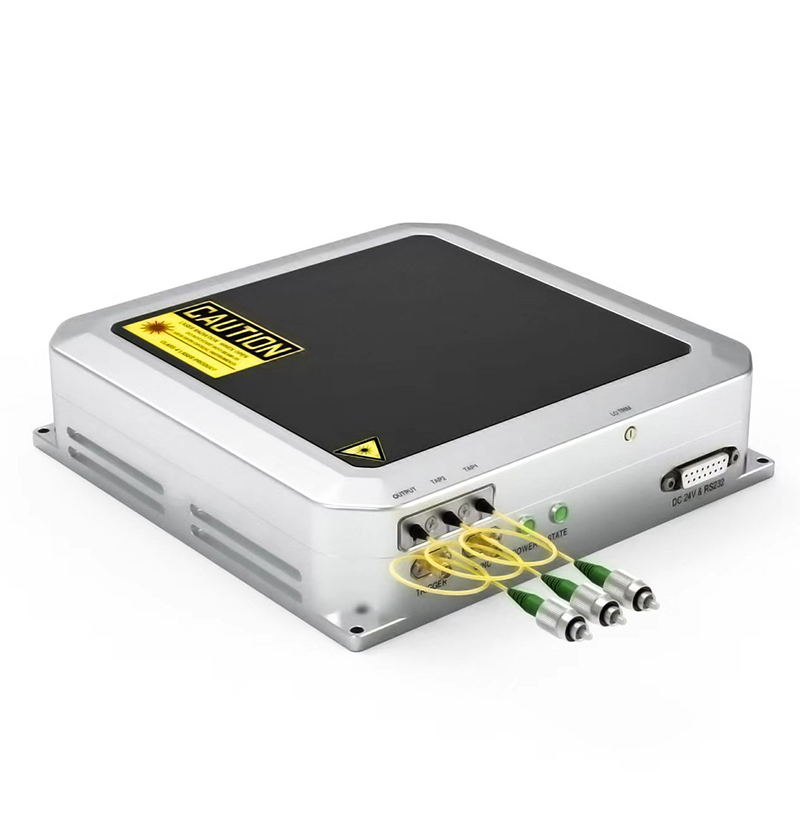
SPFL Series 1550 nm Single-Frequency Pulsed Fiber Laser
Key Features
- Adjustable pulse width
- Linewidth <1 kHz
- High peak power
- Excellent beam quality
Applications
- Coherent Doppler lidar
- Atmospheric environment monitoring
- Wind speed measurement
- Aerospace and remote sensing research
SPFL Technical Parameters
SPFL-10
| Parameter Name | Unit | Specifications | ||
|---|---|---|---|---|
| Min | Typical | Max | ||
| Optical Parameters | ||||
| Linewidth | kHz | – | – | 300 |
| Center Wavelength | nm | 1545 | 1550 | 1555 |
| AOM Frequency Shift | MHz | – | 160 | – |
| Pulse Repetition Frequency | kHz | – | 20 | – |
| Pulse Width (FWHM) | ns | 50 | – | 500 |
| Single Pulse Energy @200ns | µJ | – | 10 | – |
| Pulse Extinction Ratio | dB | 100 | – | – |
| Polarization Extinction Ratio | dB | 20 | – | – |
| Side-Mode Suppression Ratio | dB | 50 | – | – |
| Beam Quality M² | – | – | – | 1.3 |
| Output Polarization | dB | 30 | – | – |
| Power Stability RMS | % | – | – | 3 |
| Output Fiber Type | – | PM1550 | ||
| Output Method | – | Optical Switch, FC/APC interface | ||
| LO Output Power | mW | – | 2 | – |
| LO Output Fiber Type | – | PM1550 | ||
| LO Output Method | – | FC/APC interface | ||
| Coupler | – | With 50/50 Coupler | ||
| Communication Protocol | – | RS232 | ||
| Trigger Mode | – | Internal Trigger/External Trigger | ||
| Cooling Method | – | Conduction Cooling | ||
| Functional Parameters | ||||
| Power Supply | VDC | 12-24 | – | – |
| Average Power Consumption | W | – | – | 20 |
| Environmental Parameters | ||||
| Operating Temperature | °C | -40 | – | 60 |
| Storage Temperature | °C | -40 | – | 80 |
| Relative Humidity | % | – | – | 80 |
SPFL-300
| Parameter Name | Unit | Min | Typical | Max |
|---|---|---|---|---|
| Optical Parameters | ||||
| Linewidth | kHz | – | – | 300 |
| Center Wavelength | nm | 1545 | 1550 | 1555 |
| AOM Frequency Shift | MHz | – | 80 | – |
| Pulse Repetition Frequency | kHz | – | 10 | – |
| Pulse Width (FWHM) | ns | 200 | – | 600 |
| Single Pulse Energy @600ns | µJ | 300 | – | – |
| Pulse Extinction Ratio | dB | 100 | – | – |
| Polarization Extinction Ratio | dB | – | 20 | – |
| Side-Mode Suppression Ratio | dB | 50 | – | – |
| Beam Quality M² | – | – | – | 1.3 |
| Output Isolation | dB | 28 | – | – |
| Power Stability RMS | % | – | – | 3 |
| Output Fiber Type | – | PLMA-GDF-25/300 | ||
| Output Method | – | FC/APC interface | ||
| LO Output Power | mW | 2 | – | 3 |
| LO Output Fiber Type | – | PM1550 | ||
| LO Output Method | – | FC/APC interface | ||
| Coupler | – | With 50/50 coupler | ||
| Communication Protocol | – | RS232 | ||
| Trigger Mode | – | Internal Trigger/External Trigger | ||
| Cooling Method | – | Conduction Cooling | ||
| Functional Parameters | ||||
| Power Supply | VDC | – | 24 | – |
| Average Power Consumption | W | – | – | 70 |
| Environmental Parameters | ||||
| Operating Temperature | °C | -40 | – | 60 |
| Storage Temperature | °C | -40 | – | 80 |
| Relative Humidity | % | – | – | 80 |
Solid Laser’s SPFL Series High‑Performance Single Frequency Pulsed Fiber Lasers
Next-Level Fiber Lasers Built for Reliability
At Solid Laser, the SPFL Series single frequency pulsed fiber lasers are designed for researchers, photonics engineers, and industrial users. These lasers provide high spectral purity, narrow line-width and high-noise-level pulses. Built for stability and reliability, they are used for applications like spectroscopy, optical sensing and advanced industrial processes.
The SPFL Series is engineered as a Narrow Linewidth Fiber Laser platform that delivers High Spectral Stability for demanding spectroscopy and sensing applications.
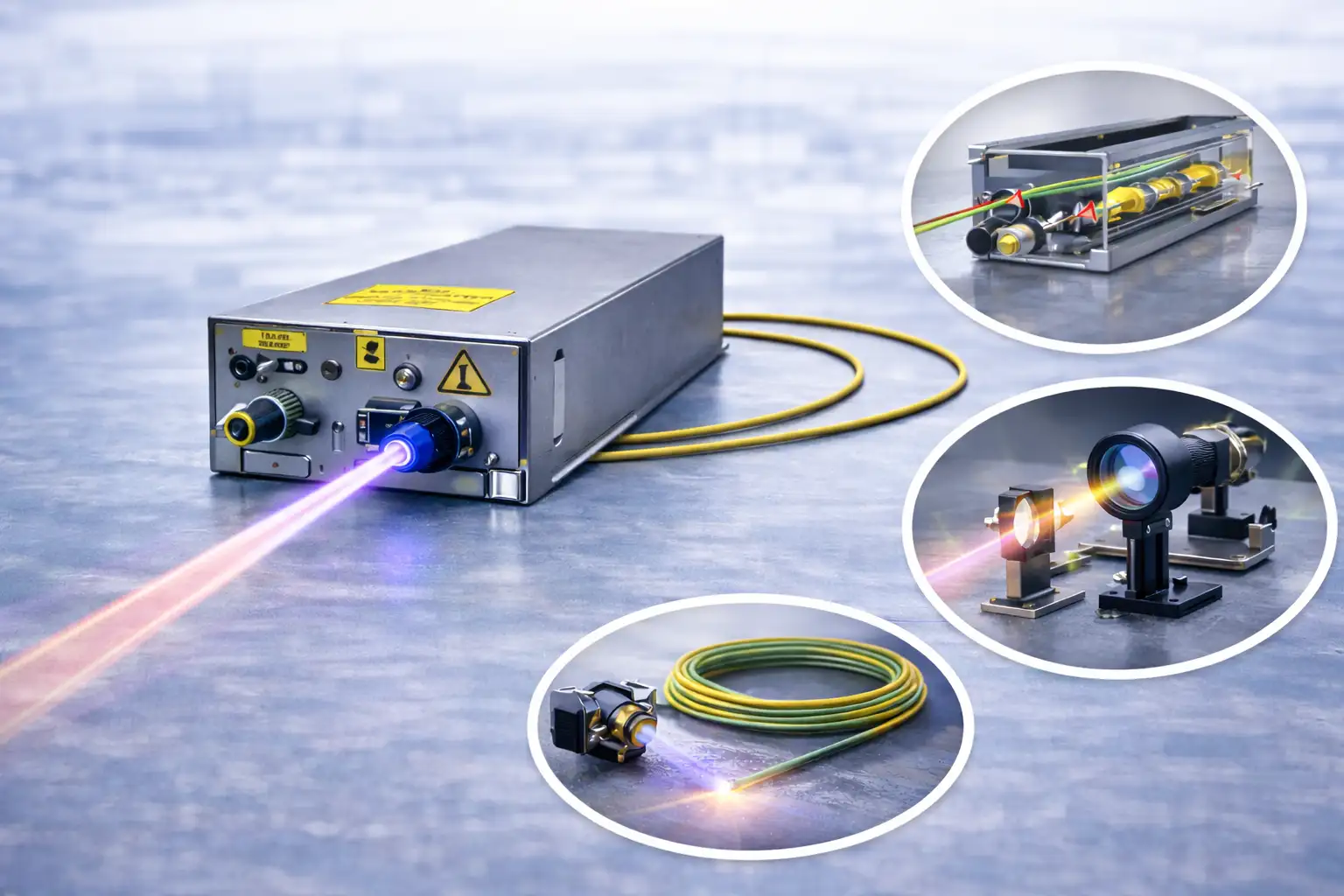
Advantages Of Choosing The Single Frequency Pulsed Fiber Laser Series
Advanced solutions need laser systems that are accurate and stable. Our Single Frequency Pulsed Fiber Laser is designed for laboratories, OEM systems and industrial setups where stable operation is essential.
Its advanced architecture supports Precision Pulse Control and Low Phase Noise, helping maintain consistent laser performance in research and industrial environments.
The SPFL Series is designed to deliver the highest level of optical performance and stable output in challenging research and industrial applications. Its small fiber structure reduces the complexity of integrating the system and ensures high signal quality and stable operation over time.
The SPFL Series offers:
- Constant pulses to achieve consistent results.
- Low spectral drift and narrow linewidth.
- High beam quality.
- Effective fiber energy transmission.
- Compact design for easy integration.
Applications Across Science and Industry
The SPFL Series at Solid Laser provides high-precision laser pulses with minimal spectral variation and delivers stability at high frequencies for use in scientific and industrial applications worldwide.
The system also provides Long Coherence Length, making it suitable for precision optical sensing, measurement, and photonics research applications.
The SPFL Series is also applicable in applications where long-term measurement performance, precise pulse timing and stable optical signals are required. The fiber laser is advanced, and is suitable for the harsh atmosphere of sensing, spectroscopy and industrial monitoring.
Common applications include:
- Chemical analysis and accuracy of spectroscopy.
- Optical sensing and detection systems.
- Time-domain reflectometry.
- Photonics research and development.
- Advanced instrumentation OEM.
- Monitoring and quality control of industrial processes.
Why Researchers Choose Solid Laser’s SPFL Series?
Our Single frequency pulsed fiber laser platforms are designed to be reliable in laboratory, OEM and industrial applications. The SPFL Series offers high performance, high efficiency fiber transmission and a narrow-linewidth, all-in-one solution for demanding analytical and photonics applications.
With high-precision optical control and fiber laser technology, Solid Laser builds the SPFL Series to deliver low spectral drift and reliable operating stability. These systems are optimized for use in applications that demand high signal quality, low phase noise and high efficiency over long durations.
Key benefits include:
- High performance and narrow line width laser.
- Accurate pulse delivery to precision measurements.
- Easy integration in scientific instruments.
- Long-term operational stability.
- Low phase noise and high beam quality.
- Efficient operation for advanced optical systems.
Frequently Asked Questions
Yes, the Single frequency pulsed fiber laser gives precise pulse timing, Precision Pulse Control, and Stable Pulse Output, making it suitable for time-resolved measurements and experiments. Its stable optical performance also supports advanced spectroscopy and high-speed photonics research applications requiring accurate pulse synchronization.
Yes, the system provides adjustable repetition rates without changing the pulse energy to ensure consistent performance of the system in the challenging research applications and Research Grade Fiber Laser environments. The Single frequency pulsed fiber laser architecture helps maintain reliable pulse consistency during continuous high-speed operation processes.
Solid Laser includes protective electronics, safety interlocks, and monitors to allow safe and stable operation of lasers while maintaining Stable Pulse Output. These integrated protection systems help ensure dependable laser operation in demanding laboratory and industrial application environments consistently.
Yes, the integrated control electronics enable people to access system status and adjust pulse parameter remotely where required for advanced Scientific Instrumentation applications. This capability improves operational flexibility for advanced Single frequency pulsed fiber laser research and monitoring environments.
The fiber-based laser design reduces energy loss, enhances efficiency and ensures that thermal load is kept low during operation while maintaining Low Phase Noise performance. Its optimized fiber architecture also supports long-term stability and reliable operation during continuous industrial processing applications.
Yes, the modular design enables SPFL lasers to integrate in multi-laser systems to support complex research, distributed fiber sensing, and experiment systems. The compact system structure also simplifies integration into advanced optical and photonics research platforms effectively.
No, the fiber-based design is designed with very low maintenance and long service life with stable and reliable performance as a Precision Spectroscopy Laser. This helps reduce operational downtime and supports efficient long-term laboratory and industrial laser system performance.
The SPFL Series can indeed be used in Distributed Fiber Sensing applications where stability, accuracy, and clear optical signal transmission are necessary. Its stable pulse delivery improves sensing precision across advanced monitoring and measurement system environments significantly.
Yes, the laser is widely used in the field of Scientific Instrumentation, where stable operation, spectral accuracy and repeatable performance are essential. The Single frequency pulsed fiber laser platform also supports reliable integration into precision laboratory instrumentation systems.
The SPFL Series is an optical research-grade fibre laser system with stable output and high lasing spectral performance suitable for advanced optical studies. Its narrow linewidth performance supports accurate spectroscopy measurements and demanding photonics research applications requiring spectral precision.
Connect with Solid Laser for Precision Fiber Lasers
Choose the SPFL Series from Solid Laser for a precise and reliable Single Frequency Pulsed Fiber Laser, ideal for advanced research and industrial applications.